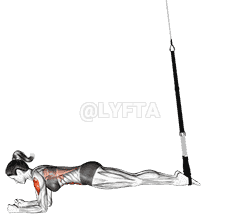
Suspension Supine Plank
Suspension Supine Plank demonstration
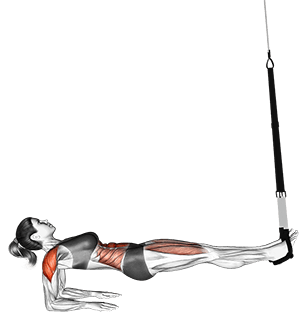
Performing the: A Step-by-Step Tutorial Suspension Supine Plank
- Lay down on your back directly under the suspension straps, extending your legs straight out in front of you and positioning your hands to hold the straps.
- Engage your core, lift your hips off the ground, and squeeze your glutes, creating a straight line from your head to your heels, similar to a plank position.
- Keep your body rigid and maintain this position for a set amount of time, ensuring your hips don't sag and your back doesn't arch.
- After holding the plank for your desired time, slowly lower your hips back to the ground, release the straps, and rest before repeating the exercise.
Tips for Performing Suspension Supine Plank
- **Engage Your Core**: One of the most common mistakes is not engaging the core muscles during the suspension supine plank. Always tighten your abdominal muscles to support your spine and ensure the effectiveness of the exercise.
- **Avoid Arching Your Back**: Arching your back can lead to back pain and injuries. To avoid this, maintain a neutral spine throughout the exercise. This means your back should be flat, not arched or rounded.
- **Keep Your Shoulders Down**: Another common mistake is shrugging the shoulders towards the ears. This can lead to neck and shoulder tension. Instead, keep your shoulders down and away from your ears.
- **Progress Gradually**: If
Can beginners do the Suspension Supine Plank?
Yes, beginners can do the Suspension Supine Plank exercise, but it might be challenging as it requires a certain amount of core strength and stability. It's recommended to start with basic exercises to build up core strength before moving into more advanced moves like the Suspension Supine Plank. It's always important to ensure correct form to avoid injury. Consulting with a fitness professional or trainer can be very beneficial for beginners.
What are common variations of the Suspension Supine Plank?
- Suspension Supine Plank with Hip Adduction: In this variation, you draw your legs together while in the plank position, targeting the inner thigh muscles.
- Suspension Supine Plank with Knee Tuck: This involves tucking your knees towards your chest while maintaining the plank position, adding a dynamic element that targets the lower abs.
- Suspension Supine Plank with Leg Extension: This variation involves extending one leg straight out while in the plank position, which challenges your balance and works your glutes and hamstrings.
- Suspension Supine Plank with Arm Reach: This involves reaching one arm straight out in front of you while maintaining the plank position, which not only challenges your balance but also works your upper body.