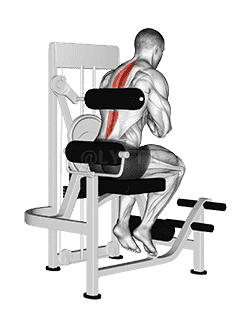
Weighted Hyperextension
Weighted Hyperextension demonstration
_Waist_small.png&w=3840&q=75)
Performing the: A Step-by-Step Tutorial Weighted Hyperextension
- Hold the weight plate close to your chest, keeping your back straight and your eyes looking forward.
- Slowly lower your upper body down as far as you can comfortably go, maintaining control and without any sudden movements.
- Then, use your lower back muscles to raise your body back up to the starting position, ensuring you don't hyperextend or arch your back at the top of the movement.
- Repeat this motion for the desired number of repetitions, always maintaining a controlled movement and ensuring your lower back is doing the work, not your arms or legs.
Tips for Performing Weighted Hyperextension
- **Proper Form**: Maintain a neutral spine throughout the exercise. A common mistake is to round or arch the back excessively, which can lead to back injuries. Instead, focus on hinging at the hips while keeping your back straight.
- **Controlled Movement**: Avoid rushing through the movement or using momentum. Lower your torso in a controlled manner and use your lower back and glute muscles to raise your body back up. This will ensure you're effectively working the targeted muscles and not putting unnecessary strain on your spine.
- **Weight Placement**: If you're using additional weight, make sure it's held securely against your chest. Holding it too far from your body can create a lever effect, increasing the difficulty of the exercise and the
Can beginners do the Weighted Hyperextension?
Yes, beginners can do the Weighted Hyperextension exercise, but it's important to start with light weights or even just bodyweight to ensure proper form and prevent injury. It's also crucial to consult with a fitness professional or personal trainer to get guidance on the correct technique. As with any new exercise, beginners should start slow and gradually increase the intensity as their strength and endurance improve.
What are common variations of the Weighted Hyperextension?
- Resistance Band Hyperextension: In this variation, a resistance band is used, which is anchored to a fixed point and held in the hands during the exercise, increasing the difficulty.
- Swiss Ball Hyperextension: This variation involves using a Swiss ball; you lay with your stomach on the ball and perform hyperextensions, which challenges your balance and engages your core.
- Single-Leg Hyperextension: This variation is performed by raising one leg while doing the hyperextension, which increases the challenge and focuses on one side of the lower back at a time.
- Medicine Ball Hyperextension: In this variation, a medicine ball is held at the chest or behind the head while performing the exercise, adding weight and increasing the intensity of the workout.