Saw
Saw demonstration
Watch the demo so setup and tempo are clear before you follow the step-by-step cues.
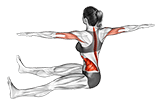
Performing the: A Step-by-Step Tutorial Saw
Work through the cues in order so setup, bracing, and reps stay consistent before you add load.
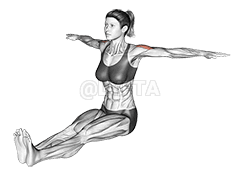
- Extend your arms out to the sides at shoulder height and twist your torso to the right.
- As you exhale, bend forward and reach your left hand towards your right foot as if you are "sawing" off your toes, keeping your right hand behind you for balance.
- Inhale and sit back up, untwisting your torso to return to the starting position.
- Repeat the movement on the other side by twisting your torso to the left and reaching your right hand towards your left foot.
Tips for Performing Saw
Form reminders that keep range of motion and control in check once the basic pattern feels stable.
- **Proper Positioning**: Start in a seated position with your legs wider than hip-width apart and your feet flexed. Extend your arms out to the sides at shoulder height. This is your starting position. Make sure your back is straight and your core is engaged.
- **Correct Execution**: Rotate your torso to the right, extending your left hand towards your right foot. Imagine you are "sawing" off your little toe. You should feel a stretch in your spine and in your left hamstring. Inhale as you return to the center and repeat on the other side.
- **Avoid Neck Strain**: A common mistake is to lead the movement with the neck or to strain the neck trying to reach the foot. Instead, focus on rotating from your waist and keep your neck in line with your spine.
Can beginners do the Saw?
A short framing note on whether this pattern suits newer lifters before you load it heavily.
Yes, beginners can do the Saw exercise, which is a popular Pilates exercise. However, it may be challenging for some because it requires flexibility and control. It's important to focus on form and technique rather than pushing to extremes. It's always recommended to start any new exercise under the guidance of a trained professional to ensure correct form and prevent injury.
What are common variations of the Saw?
Compare these progressions when the main pattern is solid or you need a different stimulus with similar equipment.
- A band saw is a power saw with a long, sharp blade consisting of a continuous band of toothed metal stretched between two or more wheels to cut material.
- A hacksaw is a fine-toothed saw, originally and mainly made for cutting metal.
- A jigsaw is a saw which uses a reciprocating blade to cut irregular curves, such as stenciled designs, in wood, metal, or other materials.
- A chainsaw is a portable, mechanical saw which cuts with a set of teeth attached to a rotating chain that runs along a guide bar.
Related Exercises
Similar library demos that share muscle or equipment focus so you can compare form cues and programming options.