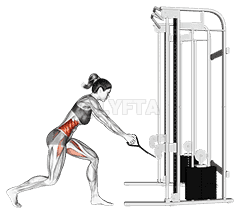
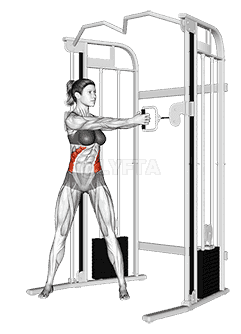
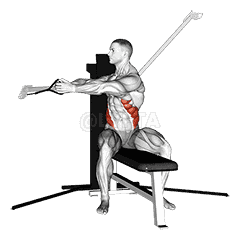
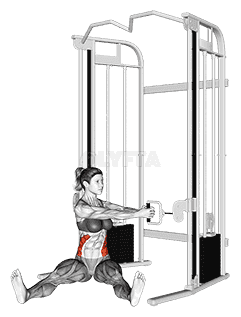
Cable twist
Cable twist demonstration
Performing the: A Step-by-Step Tutorial Cable twist
- Stand with your feet shoulder-width apart and grab the handle with both hands, arms fully extended in front of you.
- Keep your hips and legs stationary, twist your torso to the side away from the machine, pulling the cable across your body.
- Hold this position for a few seconds, then slowly return to the starting position.
- Repeat this motion for the desired number of repetitions, then switch sides to ensure balanced strength training.
Tips for Performing Cable twist
- **Maintain Core Stability**: The cable twist is a core exercise, so it's essential to keep your abs engaged throughout the movement. This will not only help you perform the twist more effectively, but it will also protect your lower back. A common mistake is to let your hips and lower body rotate with your torso, but try to keep them as stable as possible.
- **Controlled Movement**: Avoid using momentum to twist your body. Instead, use your core strength and control the movement. This will ensure that your muscles are doing the work and not your momentum.
- **Keep Your Arms Straight**: Your arms should remain fully extended and parallel to the floor throughout the exercise
Can beginners do the Cable twist?
Yes, beginners can do the Cable twist exercise. However, it's important to use a lighter weight to start with and focus on correct form to avoid any potential injury. It's also beneficial to have a trainer or experienced gym-goer assist or supervise initially to ensure the exercise is being done correctly. As with any exercise, it's essential to warm up properly beforehand and gradually increase the weight as strength and proficiency improve.
What are common variations of the Cable twist?
- Seated Cable Twist: In this variation, you perform the twist while seated, which can help to isolate the abdominal muscles and improve your balance.
- Cable Russian Twist: This variation involves a semi-squat position and twisting motion, targeting not only your core but also your lower body.
- Cable Woodchop: This variation involves a diagonal twisting motion, mimicking the action of chopping wood, which engages your entire core, shoulders, and hips.
- Single-Arm Cable Twist: This variation involves using one arm at a time to pull the cable across your body, which can help to focus on individual oblique muscles and improve unilateral strength.