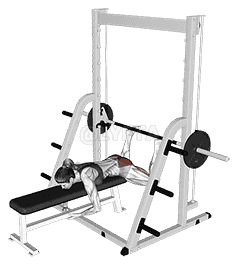
Weighted Hip Thrusts
Weighted Hip Thrusts demonstration
_Hips_small.png&w=3840&q=75)
Performing the: A Step-by-Step Tutorial Weighted Hip Thrusts
- With your hands, hold onto the barbell to keep it steady while you drive your hips upward, pushing through your heels, until your body from the knees to the shoulders is in a straight line.
- Pause for a moment at the top of the movement, squeezing your glutes for maximum muscle engagement.
- Slowly lower your hips back to the starting position, making sure to maintain control of the weight and not letting it bounce off your hips.
- Repeat this movement for the desired number of repetitions while ensuring to keep your chin tucked and not hyperextending your back during the exercise.
Tips for Performing Weighted Hip Thrusts
- **Maintain Proper Form**: Keep your chin tucked and eyes looking forward to maintain a neutral spine throughout the exercise. Avoid arching your back or letting your knees cave inward as these are common mistakes that can lead to injury. Your body should form a straight line from your knees to your shoulders at the top of the movement.
- **Controlled Movement**: Avoid the mistake of using momentum to lift the weight. Instead, make sure to lift and lower the weights in a slow, controlled manner. This will engage your muscles more effectively and reduce the risk of injury.
- **Right Weight**: Don't use too much weight too
Can beginners do the Weighted Hip Thrusts?
Yes, beginners can do the Weighted Hip Thrusts exercise. However, it's important to start with lighter weights to ensure proper form and avoid injury. It's also beneficial to have a trainer or experienced individual guide you through the exercise initially to make sure you're doing it correctly. Always remember to warm up before starting any exercise routine.
What are common variations of the Weighted Hip Thrusts?
- Single-Leg Hip Thrust: This version requires you to perform the hip thrust with one leg, increasing the intensity and focusing on one side of your body at a time.
- Glute Bridge: This is a variation where you lie flat on your back with your knees bent and lift your hips off the ground, using your body weight as resistance.
- Band-Resisted Hip Thrust: In this variation, you use a resistance band around your waist and secured to a post behind you, adding tension as you thrust your hips upward.
- Kettlebell Hip Thrust: This variation involves using a kettlebell, placed on your hips for added weight, while performing the hip thrust.