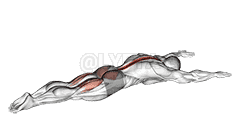
Hyperextension
Hyperextension demonstration
Performing the: A Step-by-Step Tutorial Hyperextension
- Align your upper thighs or hips with the larger pad, allowing your torso to bend forward from the waist and hang down.
- Keeping your back straight, cross your arms over your chest or place your hands behind your head.
- Slowly lift your torso until your body is in a straight line, using your lower back muscles to perform the movement.
- Lower your body back down to the starting position, ensuring you don't bend too far forward, and repeat the movement for your desired number of repetitions.
Tips for Performing Hyperextension
- **Controlled Movement**: It's important to avoid fast, jerky movements when performing hyperextensions. You should lower your upper body towards the floor slowly and in a controlled manner, then raise your torso back up to the starting position. Fast or uncontrolled movements can put unnecessary strain on your back and lead to injury.
- **Maintain a Neutral Spine**: Throughout the exercise, keep your spine in a neutral position. This means you should avoid rounding or excessively arching your back. A common mistake is to hyperextend the back at the top of the movement, which can
Can beginners do the Hyperextension?
Yes, beginners can do the Hyperextension exercise. However, it's important to start with a lighter weight or even just body weight, and focus on proper form to avoid injury. Also, it would be beneficial to have a trainer or experienced individual guide through the initial stages to ensure correct posture and technique. As with any new exercise, they should start slow and gradually increase intensity as their strength and endurance improve.
What are common variations of the Hyperextension?
- The 45-Degree Hyperextension is another version where you use a 45-degree hyperextension bench, which puts less strain on the lower back compared to the traditional hyperextension exercise.
- The Glute Ham Raise Hyperextension is a variation that involves a glute ham developer machine, focusing more on the hamstrings and glutes along with the lower back.
- The Reverse Hyperextension, performed on a reverse hyperextension machine, targets the lower back, glutes, and hamstrings, but with a different angle compared to the traditional hyperextension.
- The Cable Hyperextension is a variation where you use a cable machine, allowing you to adjust the resistance and make the exercise more challenging.