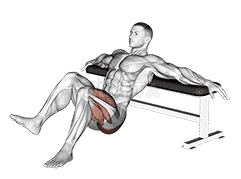
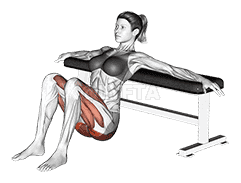
Hip Thrusts
Hip Thrusts demonstration
Performing the: A Step-by-Step Tutorial Hip Thrusts
- Roll the bar so that it is directly above your hips, and lean back against the bench so that your shoulder blades are near the top of it.
- Begin the movement by driving through your feet, extending your hips vertically through the bar, and ensure your weight is supported by your shoulder blades and your feet.
- Extend as far as possible, then reverse the motion to return to the starting position.
- Repeat the process for the desired amount of repetitions, ensuring to keep your chin tucked and not to hyperextend your back at the top of the movement.
Tips for Performing Hip Thrusts
- **Avoid Hyperextension**: A common mistake is to hyperextend the lower back at the top of the movement. Instead, focus on driving through your heels to lift the barbell, and keep your chin tucked and ribcage down to maintain a neutral spine throughout the exercise.
- **Full Hip Extension**: Make sure you're achieving full hip extension. This means your hips should be fully 'open' at the top of the movement. A common mistake is stopping short of this, which reduces the effectiveness of the exercise.
- **Keep Knees Aligned**: Your knees should be directly over your feet during the exercise. Avoid letting your knees cave in or push out too far, as this can lead to injury. 5
Can beginners do the Hip Thrusts?
Yes, beginners can certainly do the Hip Thrusts exercise. However, it's important to start with a weight that is comfortable and manageable, and then gradually increase as strength improves. It's also crucial to ensure proper form to avoid injury. It might be helpful to have a trainer or experienced individual demonstrate the exercise first.
What are common variations of the Hip Thrusts?
- Glute Bridge: This is a slight variation where you keep your back on the ground instead of elevated, focusing more on the glute muscles.
- Barbell Hip Thrust: This variation includes a barbell placed across your hips to add extra resistance and make the exercise more challenging.
- Banded Hip Thrust: In this variation, a resistance band is placed around your knees to engage the hip abductors and add an extra challenge to the movement.
- Feet-Elevated Hip Thrust: This variation involves placing your feet on an elevated surface, increasing the range of motion and intensity of the exercise.