Assisted Prone Rectus Femoris Stretch
Assisted Prone Rectus Femoris Stretch demonstration
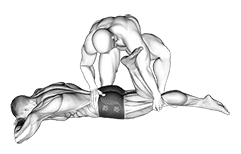
Performing the: A Step-by-Step Tutorial Assisted Prone Rectus Femoris Stretch
- Bend one knee so that your heel is moving towards your buttock, keeping the other leg straight.
- Have a partner or trainer gently hold your ankle and apply pressure, pushing your foot closer to your buttock to stretch the front of your thigh.
- Hold the stretch for 15-30 seconds, breathing deeply and trying to relax your muscles.
- Repeat the stretch on the other leg.
Tips for Performing Assisted Prone Rectus Femoris Stretch
- Gradual Stretch: Start by gently lifting the person's foot towards their buttock. The knee should remain in line with the hip, not splayed out to the side. This is a common mistake that can reduce the effectiveness of the stretch and potentially cause injury. The stretch should be felt in the front of the thigh.
- Communication: Always maintain open communication with the person you are assisting. They should tell you when they feel a stretch, and you should not push beyond this point. Overstretching can lead to muscle strains or other injuries.
- Hold and Release: Once the person feels a stretch, hold this position for about 30
Can beginners do the Assisted Prone Rectus Femoris Stretch?
Yes, beginners can perform the Assisted Prone Rectus Femoris Stretch exercise. However, it's important to note that this is a more advanced stretch and may require some flexibility. Beginners should approach it with caution and not push themselves too far to avoid injury. It's recommended to have a trained professional or physical therapist guide you through the exercise to ensure you're doing it correctly. Always remember to warm up before stretching and to stretch both sides of your body equally.
What are common variations of the Assisted Prone Rectus Femoris Stretch?
- Standing Rectus Femoris Stretch: In this variation, you stand upright, bend one knee, and hold the ankle of the bent leg behind you, pulling gently towards your buttocks to stretch the muscle.
- Seated Rectus Femoris Stretch: For this variation, you sit on the floor with one leg extended out in front of you and the other bent at the knee, pulling the foot of the bent leg towards your buttocks for the stretch.
- Supine Rectus Femoris Stretch: This variation involves lying flat on your back, bending one knee and pulling it towards your chest, then gently extending the lower leg upwards to stretch the muscle.
- Wall-Assisted Rectus Femoris Stretch: In this version, you stand facing away from a wall,