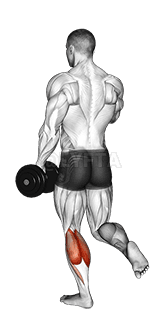
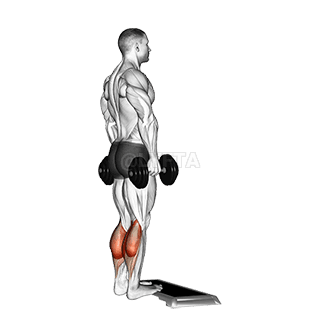
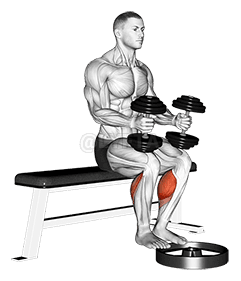
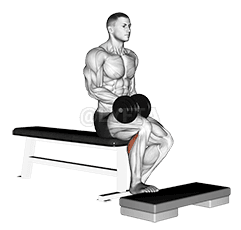
Standing Calf Raise (Dumbbell)
Standing Calf Raise demonstration
Watch the demo so setup and tempo are clear before you follow the step-by-step cues.
Performing the: A Step-by-Step Tutorial Standing Calf Raise
Work through the cues in order so setup, bracing, and reps stay consistent before you add load.
- Slowly raise your heels off the ground, shifting your weight onto the balls of your feet while keeping your abdominal muscles pulled in so that you move straight upward, not forward or backward.
- Hold the position for a moment, ensuring your calves are flexed and you're balanced on the balls of your feet.
- Gradually lower your heels back to the ground to return to the starting position.
- Repeat this movement for your desired number of repetitions, ensuring to keep your movements slow and controlled.
Tips for Performing Standing Calf Raise
Form reminders that keep range of motion and control in check once the basic pattern feels stable.
- Foot Position: Your feet should be hip-width apart and flat on the floor or the edge of a step if you're doing the exercise with a raised platform. Avoid pointing your toes inward or outward as this could strain your ankles.
- Controlled Movement: Lift your heels off the ground by pushing up on the balls of your feet and lower them back down slowly. Avoid bouncing or rushing the movement as this can lead to muscle strain and doesn't effectively work your calf muscles.
- Range of Motion: Try to raise your heels as high as possible to engage the full range of motion of your calf muscles. However, avoid overextending your ankles or pushing beyond your comfort level as this could lead to injury.
- Use Support: If you're new to the exercise or have balance
Can beginners do the Standing Calf Raise?
A short framing note on whether this pattern suits newer lifters before you load it heavily.
Yes, beginners can absolutely do the Standing Calf Raise exercise. It's a simple and effective exercise that targets the calf muscles. Here's a basic way to do it: 1. Stand up straight, ideally near a wall or a sturdy object you can hold onto for balance if needed. 2. Slowly raise your heels until you're standing on your toes. 3. Lower slowly back to the ground. Remember to keep your abdominal muscles pulled in so that you move straight upward, rather than shifting your body forward or backward. You can also modify the exercise to increase its difficulty as you get stronger, such as by holding weights or doing the exercise on one leg at a time. As with any exercise, it's important to start with a weight and difficulty level that's appropriate for you, and to increase gradually to avoid injury.
What are common variations of the Standing Calf Raise?
Compare these progressions when the main pattern is solid or you need a different stimulus with similar equipment.
- Double-leg Calf Raise: This is performed by standing on both feet and raising your body up on the balls of both feet.
- Single-leg Calf Raise: This variation is performed by standing on one leg and raising your body up on the ball of that foot.
- Jumping Calf Raises: This high-intensity variation involves jumping from a flat position into a calf raise.
- Dumbbell Calf Raise: This variation is performed by holding a dumbbell in each hand to add weight as you raise your body up on the balls of your feet.
Related Exercises
Similar library demos that share muscle or equipment focus so you can compare form cues and programming options.