Safety Bar Elevated Heel Squat
Safety Bar Elevated Heel Squat demonstration
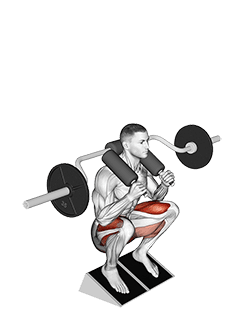
Performing the: A Step-by-Step Tutorial Safety Bar Elevated Heel Squat
- Place a small block or weight plate under your heels to create the elevation, ensuring that your feet are shoulder-width apart.
- Slowly lower your body into a squat, keeping your back straight and your knees aligned with your feet, until your thighs are parallel to the ground.
- Pause for a moment at the bottom of the squat, ensuring your core is engaged and your body is in control.
- Push back up to the starting position, driving through your heels, and repeat the exercise for your desired number of repetitions.
Tips for Performing Safety Bar Elevated Heel Squat
- Maintain Proper Form: Always keep your back straight and chest out while performing the squat. Bending or rounding your back can lead to serious injuries. Also, ensure your knees are in line with your feet and do not cave inwards as you lower your body.
- Controlled Movement: Avoid rushing through the exercise. Lower your body slowly, keeping control of the movement, then push back up through your heels. This will ensure you're engaging the correct muscles and not relying on momentum to carry you through the exercise.
- Depth of Squat: Aim to lower your body until your thighs are at least parallel to the floor. Going too shallow won't
Can beginners do the Safety Bar Elevated Heel Squat?
Yes, beginners can do the Safety Bar Elevated Heel Squat exercise. However, it's important to start with a lighter weight to ensure proper form and prevent injury. It's also recommended to have a trainer or experienced individual supervise or guide beginners through the exercise to ensure they are doing it correctly. Always remember that the key to effective strength training is not about lifting heavy weights, but about proper form and technique.
What are common variations of the Safety Bar Elevated Heel Squat?
- Goblet Squat: Instead of a barbell, this variation uses a kettlebell or dumbbell held at chest level, providing a full body workout with a focus on the quads and glutes.
- Overhead Squat: In this variation, the barbell is held overhead which significantly challenges your balance, mobility, and core strength.
- Zercher Squat: This variation involves holding the barbell in the crook of your elbows, which increases the demand on your core and upper body, while still working your lower body.
- Box Squat: This variation involves squatting down to a box or bench, which can help to improve your squat depth and form, and allows you to lift heavier weights safely.