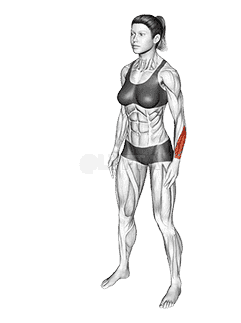
Pronator square
Pronator square demonstration

Performing the: A Step-by-Step Tutorial Pronator square
- Sit on a chair or stand upright, holding a dumbbell in your right hand with your elbow bent at a right angle. Your palm should be facing up.
- Slowly rotate your forearm so that your palm faces downward. This is the pronation movement. Ensure your elbow stays at your side and doesn't move during the exercise.
- Hold this position for a moment, then slowly rotate your forearm back to the starting position.
- Repeat this exercise for the desired number of repetitions, then switch to your left hand.
- For best results, perform this exercise 2-3 times per week on non-consecutive days.
Tips for Performing Pronator square
- Use Appropriate Equipment: This could be resistance bands or light dumbbells. Heavy weights are not necessary and can lead to injury.
- Slow and Steady: Pronation and supination movements should be done slowly and controlled. Avoid jerky or rapid movements as these can lead to injury.
- Full Range of Motion: To get the most out of the exercise, make sure you are using a full range of motion. This means rotating your forearm to its maximum extent in both directions - from palm facing down (pronation) to palm facing up (supination).
- Avoid Overtraining
Can beginners do the Pronator square?
The pronator quadratus is a muscle in the forearm that helps in rotating the hand. It's not typically targeted in beginner's exercises, but it's indirectly worked out during general forearm and grip strength exercises. Beginners can certainly do exercises that work this muscle, such as wrist curls or dumbbell rotations, but it's important to start with light weights and proper form to avoid injury. As always, it's a good idea to consult with a personal trainer or physical therapist to ensure exercises are being done correctly.
What are common variations of the Pronator square?
- In some individuals, the Pronator quadratus may be partially fused with the flexor digitorum superficialis.
- There can be a variation where the Pronator quadratus is absent entirely, a rare but documented occurrence.
- The muscle can occasionally exhibit a bifid or double-layered appearance, representing a structural variation.
- In certain cases, the Pronator quadratus may have an unusual insertion point, such as the ulna instead of the radius.