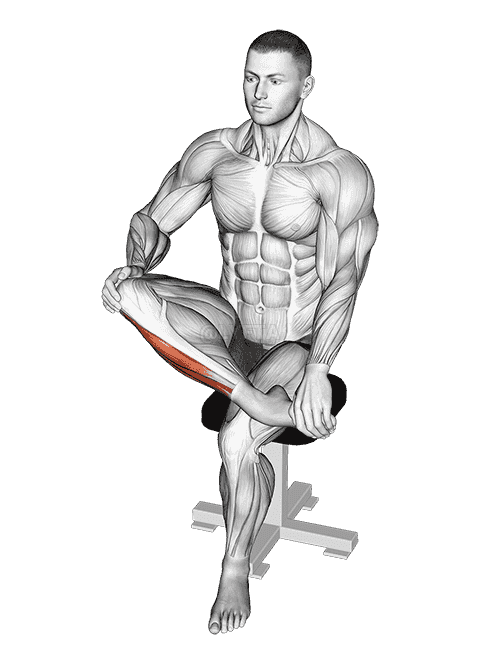
Peroneus longus
Peroneus longus demonstration

Performing the: A Step-by-Step Tutorial Peroneus longus
- Sit on the floor with your legs extended in front of you and loop a resistance band around the balls of both feet.
- Cross the band over so that it forms an 'X' and hold onto the ends of the band with both hands.
- Slowly rotate your feet outwards against the resistance of the band, focusing on the outer part of your lower legs where the Peroneus Longus is located.
- Hold this position for a few seconds, then slowly return your feet to the starting position.
- Repeat this exercise for multiple reps, ensuring to keep the movements slow and controlled to effectively work the Peroneus Longus muscle.
Tips for Performing Peroneus longus
- Proper Positioning: For most exercises targeting the Peroneus Longus, it's important to maintain the correct position. For example, if you're doing ankle eversion exercises, make sure your leg is straight and your foot is flexed. Incorrect positioning can lead to ineffective exercise and potential injury.
- Controlled Movements: Perform all movements slowly and in a controlled manner. Avoid jerky or rapid movements as these can lead to muscle strain or injury.
- Gradual Intensity Increase: Start with light resistance and gradually increase as your strength improves. Do not rush to use heavy resistance as it can lead to strain or injury.
- Consistent Stretching: Before and after the exercise, make sure to
Can beginners do the Peroneus longus?
Yes, beginners can do exercises to strengthen the Peroneus Longus, a muscle located on the outer side of the lower leg. However, it's important to start with light resistance and gradually increase as strength and flexibility improve. One simple exercise is the band resisted ankle eversion where you would use a resistance band to provide tension while you move your foot outward against the band. As with any new exercise, it's recommended to seek guidance from a professional trainer or a physiotherapist to ensure proper form and prevent injury. Also, if you have any pre-existing conditions or injuries, it's best to consult with a doctor before starting a new exercise regimen.
What are common variations of the Peroneus longus?
- Another variation can be seen when the Peroneus longus has an additional slip going towards the cuboid, making it bifurcated at its insertion.
- In some cases, the Peroneus longus muscle can be absent, which is a rare but possible anatomical variation.
- There is also a variation where the Peroneus longus has a dual tendon insertion, one on the base of the first metatarsal and the other on the medial cuneiform.
- Sometimes, the Peroneus longus may have an accessory muscle, known as the Peroneus quartus, which can alter the muscle's function and appearance.