Jab. Boxing
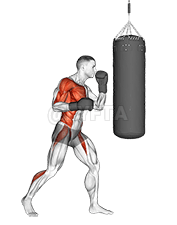
Jab. Boxing demonstration
Watch the demo so setup and tempo are clear before you follow the step-by-step cues.
Performing the: A Step-by-Step Tutorial Jab. Boxing
Work through the cues in order so setup, bracing, and reps stay consistent before you add load.
- Raise your fists up to your cheekbones, keeping your elbows close to your body to protect yourself.
- Extend your lead hand straight out in front of you, aiming for your opponent's face or body, and rotate your fist so your palm faces down when you punch.
- After landing the jab, quickly pull your fist back to its original position to protect your face.
- Repeat this process, making sure to maintain your balance and not overextend your reach to avoid leaving yourself open to counterattacks.
Tips for Performing Jab. Boxing
Form reminders that keep range of motion and control in check once the basic pattern feels stable.
- **Use Your Body**: A common misconception is that punches only involve the arm. This is not the case. Power comes from the ground up, so use your legs and hips to drive the punch. Pivot your front foot and rotate your hips and torso as you jab. This will not only increase your power but will also protect you from counter punches.
- **Keep Your Distance**: The jab is a long-range punch, so use it to keep your opponent at a distance. If you're too close, you'll lose power and leave yourself open to counter punches. Always return your hand quickly to its guard position after throwing a
Can beginners do the Jab. Boxing?
A short framing note on whether this pattern suits newer lifters before you load it heavily.
Yes, beginners can definitely do the jab boxing exercise. It's actually one of the first punches that beginners learn in boxing. The jab is a quick, straight punch thrown with the lead hand, which for right-handers is the left hand, and for left-handers is the right hand. Here's a simple way to do a jab: 1. Stand in a basic boxing stance. Your left foot should be in front if you're right-handed, or your right foot in front if you're left-handed. 2. Keep your fists up in front of your face for protection. 3. Extend your lead hand out straight in front of you. 4. As you punch, rotate your arm so that the palm of your hand is facing down towards the floor at the end of the punch. 5. After you jab, quickly retract your hand back to its original position in front of your face. Remember to keep your other hand up to guard your face and body while you're throwing a jab
What are common variations of the Jab. Boxing?
Compare these progressions when the main pattern is solid or you need a different stimulus with similar equipment.
- The Power Jab: This is a more forceful version of the basic jab, where the boxer puts more weight and rotation into the punch to deliver a stronger impact.
- The Double Jab: This involves quickly throwing two jabs in succession, which can be used to keep an opponent at distance or set up a power punch.
- The Body Jab: Instead of aiming for the head, the boxer targets the opponent's body, often used to lower an opponent's guard or to slow down their movement.
- The Feint Jab: This is a deceptive move where the boxer pretends to throw a jab but holds back, aiming to provoke a reaction from the opponent and create an opening for a follow-up punch.
Related Exercises
Similar library demos that share muscle or equipment focus so you can compare form cues and programming options.