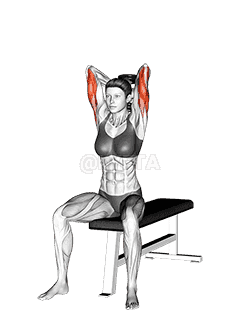
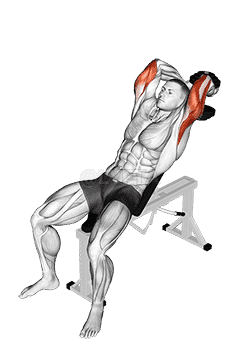
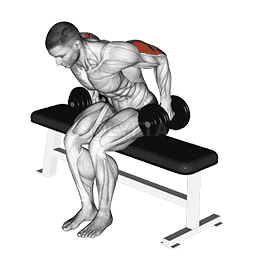
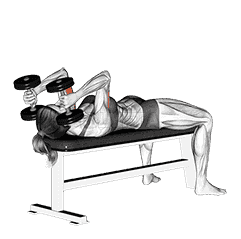
Dumbbell Standing Kickback
Dumbbell Standing Kickback demonstration
_Upper-Arms_small.png&w=3840&q=75)
Performing the: A Step-by-Step Tutorial Dumbbell Standing Kickback
- Keep your back straight and your head up, while also keeping your upper arms stationary, exhale and extend your arms back as you flex your triceps.
- Hold for a second at the contracted position and make sure that only your forearms move.
- As you inhale, slowly lower the dumbbells back to the starting position.
- Repeat the movement for the desired number of repetitions.
Tips for Performing Dumbbell Standing Kickback
- Controlled Movements: Avoid swinging the dumbbell. Instead, use a controlled, steady movement to lift and lower the dumbbell. This not only ensures that your muscles are fully engaged, but also reduces the risk of injury.
- Elbow Position: A common mistake is to move the elbows during the exercise. Your elbows should be kept close to your body and should not move up and down. The only part of your arm that should be moving is the part from your elbow to your hand.
- Weight Selection: Do not use a weight that is too heavy. This can lead to improper form and potential injury. Choose a weight that allows you to perform the exercise with
Can beginners do the Dumbbell Standing Kickback?
Yes, beginners can certainly do the Dumbbell Standing Kickback exercise. However, it's important to start with a lower weight to ensure proper form and avoid injury. It's also beneficial to have someone knowledgeable in fitness, like a personal trainer, observe your form when you're just starting out. As with any exercise, it's crucial to listen to your body and not push too hard too quickly.
What are common variations of the Dumbbell Standing Kickback?
- Incline Dumbbell Kickback: This variation is performed on an incline bench, which changes the angle of the exercise and targets different parts of the triceps.
- Bent-Over Dumbbell Kickback: In this variation, you bend over at the waist while performing the kickback, which adds an extra challenge to your balance and core strength.
- Dumbbell Kickback with Resistance Bands: Adding resistance bands to your dumbbell kickbacks can increase the resistance and make the exercise more challenging.
- Seated Dumbbell Kickback: This variation is performed while seated on a bench, which can help those with lower back problems to perform the exercise more comfortably.