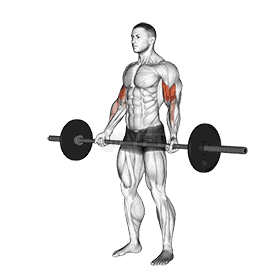
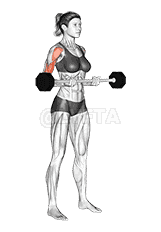
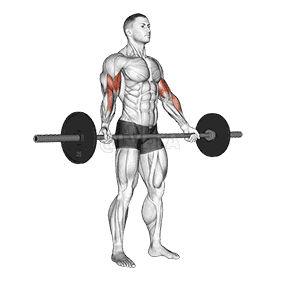
Barbell Curl
Barbell Curl demonstration
_Upper-Arms_small.png&w=3840&q=75)
Performing the: A Step-by-Step Tutorial Barbell Curl
- While keeping your upper arms stationary, exhale and curl the weights while contracting your biceps; continue to raise the weights until your biceps are fully contracted and the barbell is at shoulder level.
- Hold the contracted position for a brief moment as you squeeze your biceps.
- Inhale and slowly begin to lower the barbell back to the starting position.
- Repeat the process for the recommended amount of repetitions.
Tips for Performing Barbell Curl
- Avoid Using Your Back: One common mistake is using your back to lift the weight. This not only reduces the effectiveness of the exercise on your biceps but also puts you at risk for back injury. To avoid this, keep your back straight and your elbows close to your body throughout the exercise.
- Control the Weight: Another mistake is letting the weight drop quickly after lifting it. This can lead to muscle injury. Instead, lower the weight slowly and in a controlled manner to maximize the effectiveness of the exercise and reduce the risk of injury.
- Don't Fully Extend Your Arms: When lowering the weight,
Can beginners do the Barbell Curl?
Yes, beginners can do the Barbell Curl exercise. However, it's crucial to start with a light weight to ensure you can maintain proper form and avoid injury. It's also helpful to have a trainer or experienced person guide you initially to ensure you are performing the exercise correctly. As you get stronger and more comfortable with the exercise, you can gradually increase the weight.
What are common variations of the Barbell Curl?
- Hammer Curl: This variation involves holding the barbell with a parallel grip, which engages not only the biceps but also the brachialis and brachioradialis, muscles of the forearm.
- Incline Barbell Curl: Performed on an incline bench, this variation of the barbell curl allows for a greater range of motion and targets the long head of the biceps more intensely.
- Drag Curl: In this variation, you keep the barbell close to your body and drag it upward, which helps to isolate the biceps and limit the involvement of the shoulders and back.
- Concentration Curl: This barbell curl variation is performed while seated with the elbow resting against the inside of the thigh, helping to isolate the biceps and